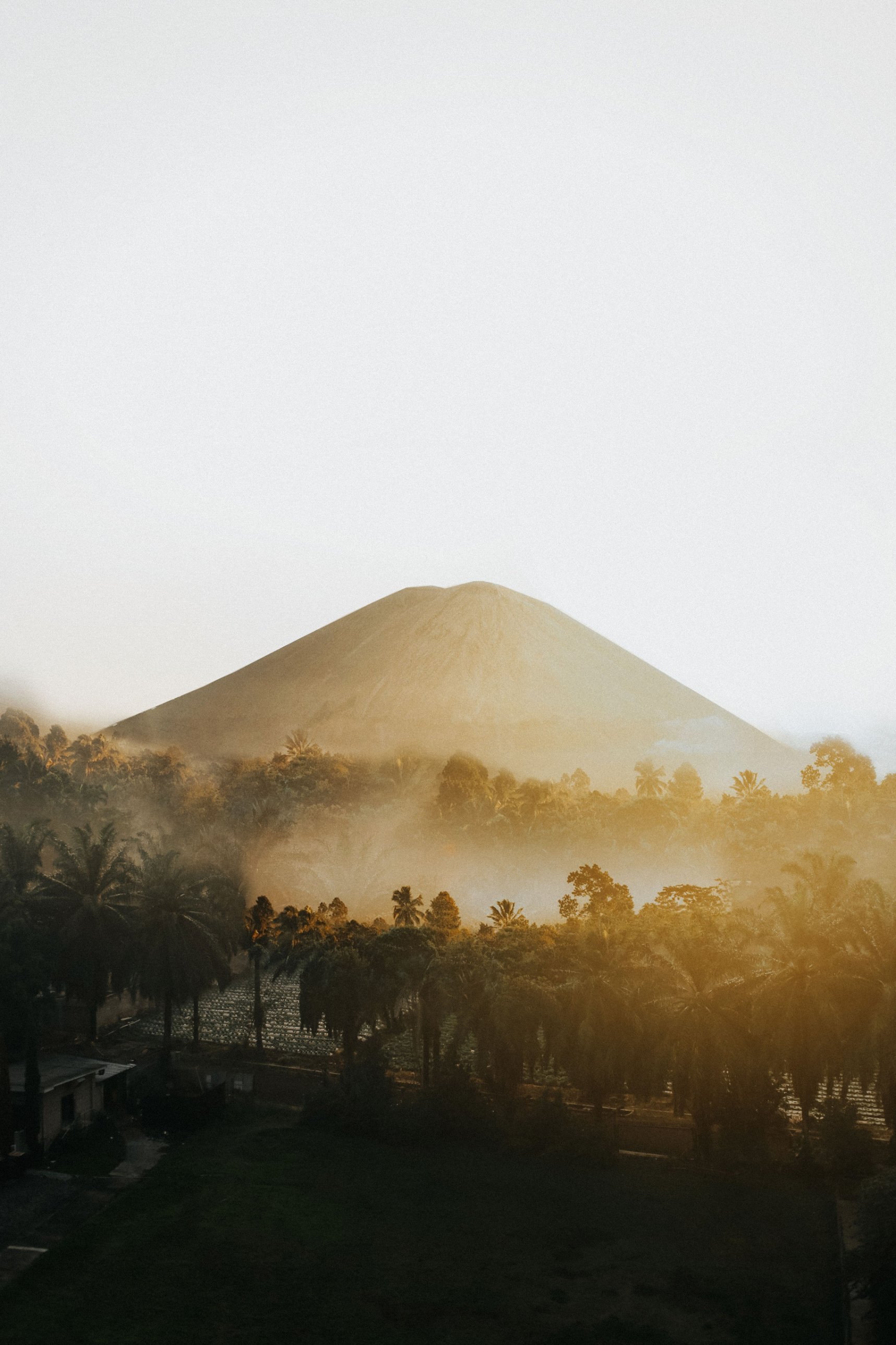
High above the village of Moni in central Flores, three lakes fill the craters at the top of Mount Kelimutu, and no two years look quite the same. One turns from green to brown to near black, another shifts through turquoise and milky blue. For the Lio people who farm the slopes below, the lakes are where the souls of the dead go to rest.
What is Kelimutu National Park?
Kelimutu National Park (Taman Nasional Kelimutu) is a small mountain park in Ende Regency on Flores, built around a volcano with three crater lakes that change colour. The area was first protected as a nature reserve in 1984, and a forestry ministry decree of 26 February 1992 made it a national park covering 5,356.5 hectares, about 54 km². It is one of Indonesia's smallest national parks and one of its most famous sights.
The volcano itself, Kelimutu, rises to 1,639 metres, and the park's highest point is Mount Kelibara at about 1,731 metres. Below the summit the slopes are covered in montane forest and farmland, and the park is ringed by farming villages such as Pemo, Woloara, Nduaria and Wologai. Most visitors see only one part of it: the summit ridge and its viewpoints over the lakes, reached by a short walk from a car park.
There is more to the park than the craters. A 4.5 hectare arboretum near the road holds 78 tree types. Plants found only here include a begonia named Begonia kelimutuensis and the rhododendron Rhododendron renschianum, and two endemic rodents live in the forest. Long-tailed macaques patrol the car park and paths.
Why do the Kelimutu lakes change colour?
The colours come from chemistry, not algae or reflections. Each lake is fed by volcanic gases and fluids from below, and the balance between that input and rainwater changes how much iron, manganese and sulphur is dissolved and in what form. As that balance shifts, a lake can move from turquoise to green, brown or almost black, and each lake changes independently of the others.
The changes can be fast. The Smithsonian's Global Volcanism Program records the eastern lake, Tiwu Ata Polo, as reddish in 1986 and dark green by 1989, and in 2024 it turned from green to blackish brown. In June 2026 the middle lake warmed from 28.4 °C to 35 °C and shifted from bluish green to light green. Volcanologists treat sudden colour and temperature changes as warning signs, which is why the lakes are monitored from an observation post at Waturaka, below the mountain.
Colour charts in guidebooks go out of date quickly. Expect to see something different from the photos you have looked at, and enjoy that as part of the visit.
What do the three lakes mean to the Lio people?
For the Lio people of central Flores, the lakes are the resting place of the dead. Tiwu Nuwa Muri Koo Fai, the lake of young men and maidens, receives the souls of the young. Tiwu Ata Mbupu, the lake of old people, takes the souls of the elderly. Tiwu Ata Polo, often translated as the bewitched or enchanted lake, is where the souls of the wicked are believed to go.
Tiwu Ata Polo and Tiwu Nuwa Muri Koo Fai lie side by side, separated only by a narrow crater wall, while Tiwu Ata Mbupu sits apart on the western side of the summit.
Every year in mid-August the communities around the park hold Pati Ka Du'a Bapu Ata Mata, a ritual to feed the ancestral spirits. In 2023 and 2025 it took place on 14 August. Twenty-two mosalaki, the customary leaders of the surrounding villages, lead a silent, barefoot procession to an altar near the lakes with offerings of red rice, meat, betel nut and tobacco, and the day ends with a Gawi circle dance. Visitors can attend; dress modestly and follow the lead of the mosalaki.
What is the Kelimutu sunrise walk like?
The classic visit is a sunrise trip from Moni: leave around 4.30 am, drive up to the car park, and walk 20 to 30 minutes on a paved path and stone steps to the viewpoints. It is easy enough for most ages, but the steps to the top viewpoint are steep. Bring a warm layer, since it is cold at the summit before dawn.
The path forks near the top. One branch leads to the railing above the twin lakes of Tiwu Ata Polo and Tiwu Nuwa Muri Koo Fai; the other climbs the stairs to the summit platform, often called Inspiration Point, where you can see all three lakes at once. On the drive up, the ridge just below the entrance looks out toward the Savu Sea. Mornings often start in cloud. Many visitors find the light just as good, and the crowds thinner, between about 7 and 9 am.
Many people walk part of the way back to Moni rather than driving, a descent of about two to three hours through forest, fields and villages. If you have time, combine Kelimutu with Wologai, a traditional Lio village near the park, where you may be asked to wear an ikat sarong before entering.
Is Kelimutu volcano active and is it safe to visit?
Kelimutu is an active volcano, but it has not erupted since minor steam-driven explosions in 1968, and in August 2026 it stood at Level I (Normal), the lowest of Indonesia's four alert levels. At that level the viewpoints are open, but visitors must stay behind the fences. Check the current level on the MAGMA Indonesia app or website before you go.
The status does change. On 24 May 2024 the volcano was raised to Level II (Waspada) after colour changes and rising seismic activity, and a 250 metre zone around the crater rim was closed. Visits were cut to the morning, the twin-lake viewpoint was off limits, and time at the top was capped at an hour until the level returned to Normal on 23 September 2024. A similar alert ran from June to July 2013.
The main risks are sudden steam explosions, volcanic gas and unstable crater walls. In July 2026 geologists still advised visitors to keep away from the crater rim, especially at the middle lake. In early August 2026 part of the wall between the twin lakes collapsed, which the geological agency put down to weathered rock rather than volcanic activity. Do not climb past the railings, do not go down to the water, and do not stay overnight near the craters. People have fallen into the lakes in the past, and the slopes are steep and loose.
When is the best time to visit Kelimutu?
The dry season, roughly May to October, usually gives the clearest skies and the best chance of a sharp sunrise over all three lakes. From November to April the wet season brings more cloud and rain, and the summit can stay in fog all morning. The park is open all year.
Even in the dry months clouds come and go, so plan at least two mornings in Moni if seeing the lakes clearly matters to you. In mid-August the Pati Ka ritual draws local and foreign visitors to the summit, so expect more company.
How do you get to Kelimutu?
The base for Kelimutu is Moni, a village on the main road between Ende and Maumere. The nearest airports are Ende (ENE), about two hours' drive away, and Maumere (MOF), about three hours away. Labuan Bajo is the usual connection by air, with Wings Air flying to Ende in about an hour; schedules change often, so check them before you book.
From Moni a paved road climbs about 13 km to the car park, a 30 to 45 minute drive with tight hairpin bends. Homestays in Moni arrange cars and motorbike taxis for the sunrise run, or you can rent a scooter. Shared vans and buses run along the main road from Ende and Maumere, and many travellers include Kelimutu on an overland trip across Flores from Labuan Bajo, with the drive from Ende taking around two hours.
What does it cost to visit Kelimutu National Park?
Travel reports from 2025 and 2026 put the foreign visitor fee at around IDR 150,000 on weekdays and IDR 225,000 on weekends and public holidays, with Indonesian visitors paying a few thousand rupiah and a small parking charge on top. Holders of KITAS or KITAP residence permits have been reported paying the foreign rate. Fees do change, so check before you go and carry cash for the gate.
After the 2024 alert ended, the park set visiting hours of 5 am to 5 pm, with tickets sold until 4 pm. Some recent visitors report later closing times, so confirm locally if you plan a late visit. Moni has simple homestays and guesthouses; bring enough cash from Ende or Maumere for your stay.
How to visit Kelimutu responsibly
For the Lio, the summit is sacred ground, so behave as you would at a cemetery: keep your voice down, do not throw anything into the lakes, and leave offerings and altars untouched. Stay on the paths and behind the fences, do not feed the macaques, and carry your rubbish down. Stay with a local family in Moni, hire local drivers and guides, and buy ikat directly from the weavers in nearby villages.
