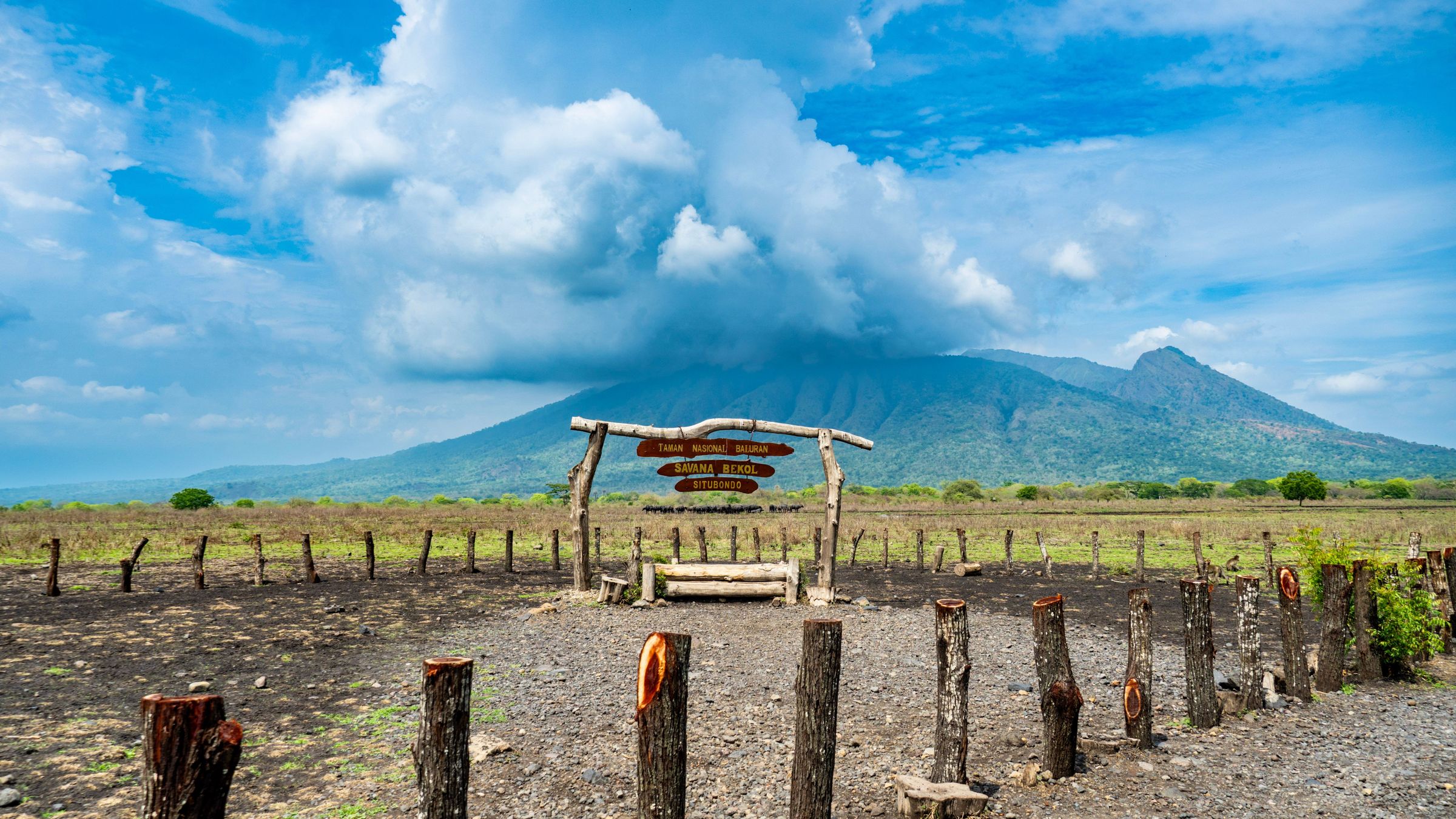
At the far northeastern corner of Java, where the island almost touches Bali, the rainforest gives way to open grassland, thorn scrub and a solitary extinct volcano. Baluran is the driest corner of Java, and in the dry season its savanna turns gold and its herds come to the waterholes, which is why Indonesians call it Africa van Java.
What is Baluran National Park?
Baluran National Park (Taman Nasional Baluran) is a protected area of about 25,000 hectares at the northeastern tip of Java, in Situbondo Regency, East Java. It became a national park in 1980 and is known for its savanna, which covers around 40 percent of the park and gives it the nickname Africa van Java. It is one of the last strongholds of the wild Javan banteng.
Protection here is older than the park. The Dutch hunter A.H. Loedeboer pushed for the area to be conserved, and in 1937 the colonial government made it a wildlife reserve. The park is bounded by the Madura Strait to the north, the Bali Strait to the east and two rivers, the Bajulmati and the Klokoran, to the west and south. At its centre stands Mount Baluran, an extinct volcano of 1,247 metres.
Savanna is only part of the picture. The park also holds lowland and evergreen forest, coastal forest and mangroves, and about 444 plant species have been recorded, including drought-adapted trees such as tamarind and the gebang palm.
What wildlife can you see in Baluran?
Baluran is one of the easiest places in Java to see large wild animals in the open. The park records about 26 mammal species and, after a 2012 revision, around 196 bird species. Rusa deer, wild boar, water buffalo, long-tailed macaques and green peafowl are the animals most visitors see; the Javan banteng is the prize.
The banteng, Java's wild cattle, is the park's emblem and its biggest conservation story. Counts fell from 338 animals in 1996 to just 26 in 2012, driven by poaching and a shrinking savanna. A breeding sanctuary inside the park now raises banteng to add genetic variety to the wild herd, and in September 2020 two bulls bred there were released with GPS collars, the first such release in Indonesia. Camera-trap estimates rose to around 211 animals by 2023.
Rarer residents include the dhole (Asiatic wild dog), the Javan leopard, the Javan lutung and hornbills, but sightings of these are a matter of luck. The Javan tiger survived here until the mid-1960s and is now extinct.
What are the main highlights inside Baluran?
The classic visit follows one road: from the Batangan gate through forest to Bekol savanna, about 12 km in, and then on to Bama beach, about 3 km further. Most people do it in a half day by car or motorbike, stopping wherever animals appear.
Bekol is the heart of the park, an open plain with Mount Baluran rising behind it. It has a waterhole, a viewing tower, a small cluster of park buildings with simple rooms, and a campground. Early morning and late afternoon are the best times, when deer, buffalo and peafowl move into the open and, with luck, banteng appear at the forest edge.
Bama is a white-sand beach on the Bali Strait backed by mangroves, with coral just offshore for snorkelling and simple accommodation. Along the way, guides point out an evergreen forest section that stays green when the savanna has dried out, and a Japanese-era cave, Gua Jepang. Other beaches, such as Bilik-Sijile and Merak in the west, are reached on separate routes.
Why is the Baluran savanna shrinking?
The main threat to the savanna is an invasive thorn tree, Acacia nilotica. After wildfires in the late 1960s, it was planted as a firebreak; it then spread across the grassland and by recent counts occupies at least 6,000 hectares, crowding out the grass that banteng and deer need.
The park now clears acacia from Bekol as routine work, and since January 2026 it uses its weekly closure day partly for that task. Poaching remains the other long-standing pressure on banteng. The banteng breeding sanctuary inside the park is part of the same effort to rebuild the herd.
When is the best time to visit Baluran?
The best time to visit Baluran is the dry season, roughly June to October. The savanna is golden, water is scarce, and animals gather around the waterholes at Bekol, which makes them far easier to spot. The rainy months turn the grass green, and January and February can bring flooding that makes parts of the park hard to reach.
Each season has its own draw. Rusa deer rut around July and August, and green peafowl display in October and November. Go as early in the day as you can: the light is better, the heat is lower and the animals are more active.
In 2026 the park also runs on a fixed rhythm. Since 27 January 2026, all three gates (Batangan, Watunumpuk and Perengan) close every Monday, unless that Monday is a public holiday, and on set days around national holidays. Closures for fire, heavy rain or other conditions are announced separately, so check the park's channels before you set off.
Was Baluran affected by fires in 2026?
Yes. During the long 2026 dry season, fires burned about 2,207 hectares of the park between May and August, according to a report published in September 2026. The park said most of its area was unaffected and that animals could move to safer ground. No closure of the visitor route was reported.
Savanna fires are a recurring risk here from the middle of the dry season onward. The park works with Manggala Agni, the forestry ministry's fire brigade, and asks everyone to avoid burning anything near the park. Never drop cigarettes, and expect incidental closures if a fire is active near the road.
How do you get to Baluran National Park?
The main entrance, the Batangan gate, sits on the north coast road between Banyuwangi and Situbondo, near the village of Wonorejo. It is about 30 minutes by road from Ketapang, the ferry port for Bali, so Baluran pairs easily with a crossing from Gilimanuk or a trip to Ijen.
Banyuwangi Airport is the nearest airport, with flights from Surabaya and Denpasar; check current schedules before you book. From Surabaya the overland drive along the northern coast takes about six hours. Buses running between Banyuwangi and Situbondo can drop you at the gate.
Inside the park there is no public transport. A hired car with driver or a motorbike is the practical choice, and ojeks have run from the gate to Bekol and Bama. The internal road has long had rough sections, and mobile signal fades once you are inside.
What does it cost to visit Baluran National Park?
Fees are set nationally and have changed several times. A 2025 overview listed about IDR 205,000 for foreign visitors at the Batangan gate and IDR 21,000 for Indonesians on weekdays (IDR 31,000 on holidays), plus around IDR 10,000 to park a car or IDR 5,000 for a motorbike. Check the current rate before you go.
Tickets are usually bought at the gate, and opening hours were listed as 07:30 to 16:00 daily, Mondays now excepted. The park's 2026 plan aims to move more entrances to e-ticketing and cashless payment, but bring cash in case. Drone flying and commercial filming need separate permits with their own fees.
Simple rooms at Bekol and Bama were listed at around IDR 100,000 to 300,000 a night in 2025. Food inside the park is limited to small stalls, so stock up in Banyuwangi or Situbondo.
Is Baluran safe to visit?
Baluran is safe for visitors who stay on the roads and marked areas and respect the wildlife. The main hazards are heat, dehydration, rough roads and animals that are wild, not tame. Banteng and buffalo are large and unpredictable, so keep your distance and never walk towards a herd.
Carry plenty of water, a hat and sun protection, especially on the open savanna. Keep food out of sight of the long-tailed macaques, which live around the visitor areas. Leave the park before dark: the road is slow, unlit and shared with animals, and storms in the wet season have brought down trees on the route.
How to visit Baluran responsibly
Stay in your vehicle or on the paths around Bekol and Bama, keep your voice down, and let animals come and go on their own terms. Never feed the monkeys or deer. Take all rubbish out with you, avoid single-use plastic, and on the reef at Bama never stand on coral. In the dry season, any spark can start a fire, so be careful with stoves and cigarettes. Paying your entry fee and using local drivers and guides helps fund the work that brought the banteng back from 26 animals.
